

TL;DR
Every time you use a website like Google or ChatGPT, your browser and a collection of backend services have a long and surprisingly candid conversation about what you asked for. That conversation sits in plain sight in the Network tab of Chrome DevTools, a single F12 away, and most people never look at it. I have spent an unreasonable amount of my time staring at this data, and want to share what I’ve learned with you.
Staring into this network abyss is what turned up a Google search exploit worth a $13,337 bug bounty. It provided actual data that gave some insight into how Google was working, including not only names of their parameters, but actual vaues for things such as Google’s site_quality_score, and Google’s own rq_semantic_class (which became QueryClassifier). It also led me to be one of the first to discover the different source sets ChatGPT pulls its results from, and later, the freshness windows it asks for when it searches, and evidence that Reddit is still being read by ChatGPT just as much as ever, even though it has largely stopped being cited.
None of this needs a data science team. It needs curiosity, a browser, and these days an AI agent willing to do the tedious bits. The point is not that network data is cool (it is, mildly). The point is that knowing things your competitors don’t is the closest thing SEO has to a sustainable edge, and this is one of the last places those things are still lying around for free.
Why anyone would do this to themselves
“Why?” is a reasonable question, and one I suspect most SEOs ask the bathroom mirror most mornings. Anyone that knows me, knows I enjoy playing games, particularly video games, and I love a new challenge of figuring out how to win. That is the game for me.
Case in point, my best friend recently taught me backgammon. As with any new game, I learned the rules and then lost repeatedly; learning the rules of a game is not the same as knowing how to play well. I think I lost around twenty or thirty games on the trot. They say fifty. The figure is contested. At some point during this run of humiliation, rather than simply enjoying a pleasant board game like a well-adjusted adult, I started figuring out how to get small edges. For instance, working out which distances on the board are actually reachable from two dice, and how likely each one is. That matters, because it tells you where you need to block your opponent and where you can safely leave a piece exposed.

As I see it, SEO works the same way. You can learn every best practice in the guide and you will still be bad at it until you have experience and learn how to play the game.
Optimisation is the sum of cumulative gains and edges. Gaining this knowledge allows you to stack 1% on your competition overtime in a way that is impossible for that to imitate. This isn’t some “hack” technique like a listicle they can copy in 10 minutes.
The paper, scissors, rock analogy
I discovered an anology that I know others find useful to explain this approach to clients or managers with the game paper, scissors, rock.
Here’s the scenario:
Imagine you are playing endless rounds against someone whose stated strategy is to play rock every single time. What is the optimal way to play against them?

Most people immediately say “play paper every time” is the optimal way to approach this problem, and they would be wrong. While you will win the first five or ten games, your opponent, who is not a houseplant, notices they are losing every game and changes what they are doing. This then steals any advantage you have an puts you back onto an even footing.
The optimal approach is to play randomly but play paper slightly more often. Your ‘optimisation’ will likely not be perceptible by your opponent and with no obvious reason to adapt, you slowly, quietly carve out an ever-increasing lead over time.
Blackhat vs Whitehat; expected value (EV)
The paper, scissors, rock analogy essentially encapsulates the argument between blackhat and whitehat SEO approaches.
Blackhat SEO absolutely works, and you can make a great deal of money. In the analogy we outlined above, blackhat SEO is the “playing paper every time” strategy. It is effective, your short term expected value (EV) is high, but you force the other side (Google, ChatGPT, whoever) to change what they do, at which point your advantage evaporates and occasionally takes your domain with it.
Whitehat SEO is the “play paper slightly more” approach, which focuses on generating value without anyone needing to change the rules, and to stack it up over time.
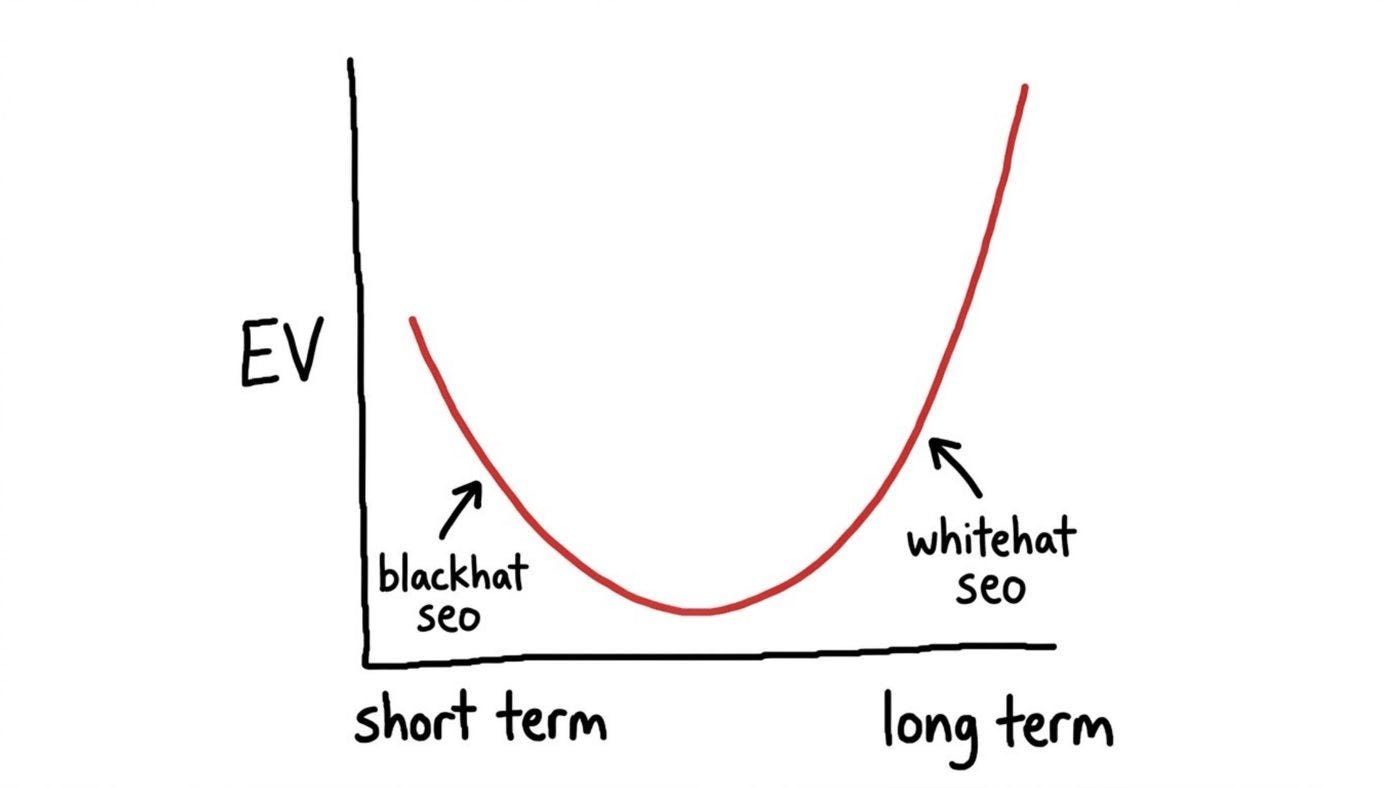
Network data is one of the best places I know to find this kind of information to give you an edge over the competition.
What network data actually is
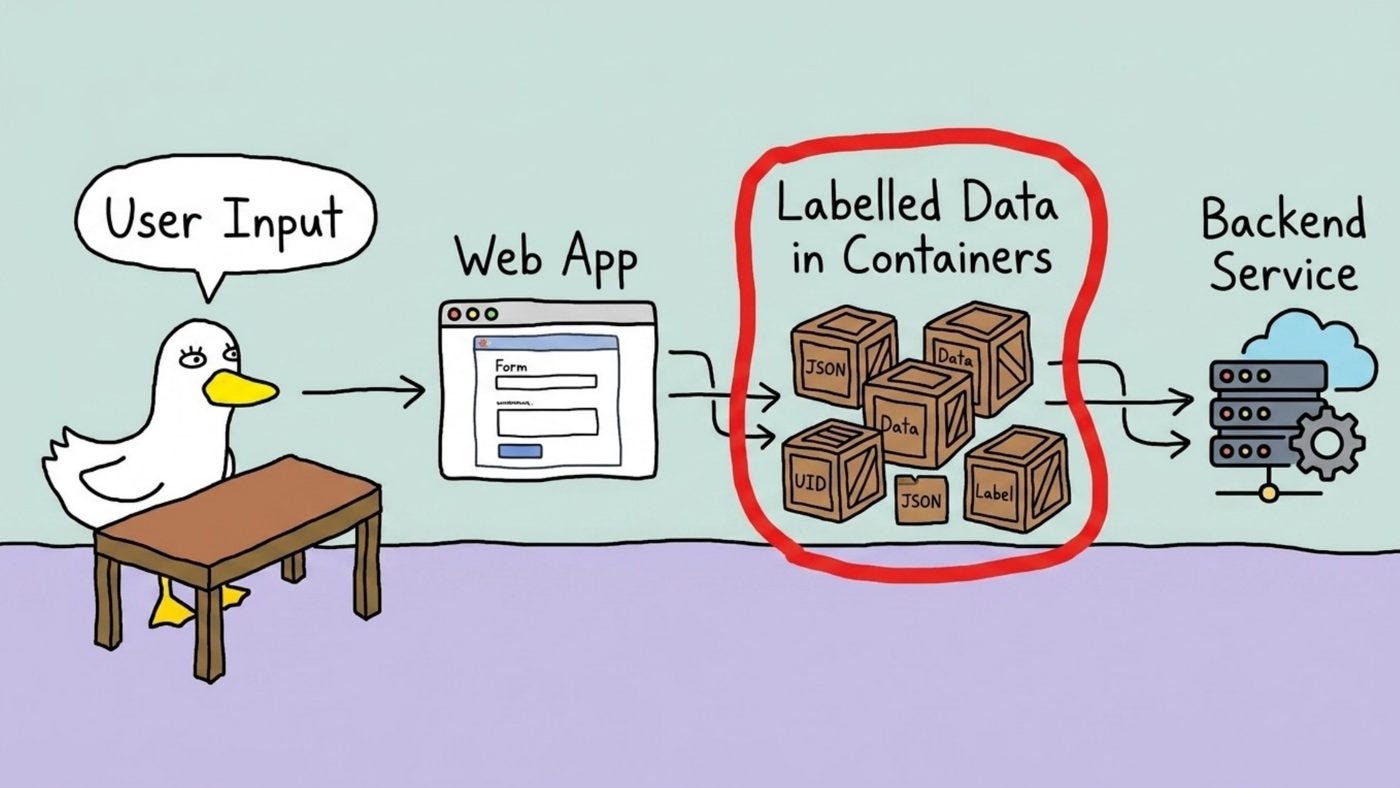
When you use a web app like Google or ChatGPT, your browser is sending data to backend services and receiving data back. The least technical way I can describe it is shipping crates travelling to and from a warehouse.
Some crates have clear labels, so you know roughly what is inside. Some have labels that make no sense whatsoever. And some you can simply open, look inside, and infer what is going on from the contents.
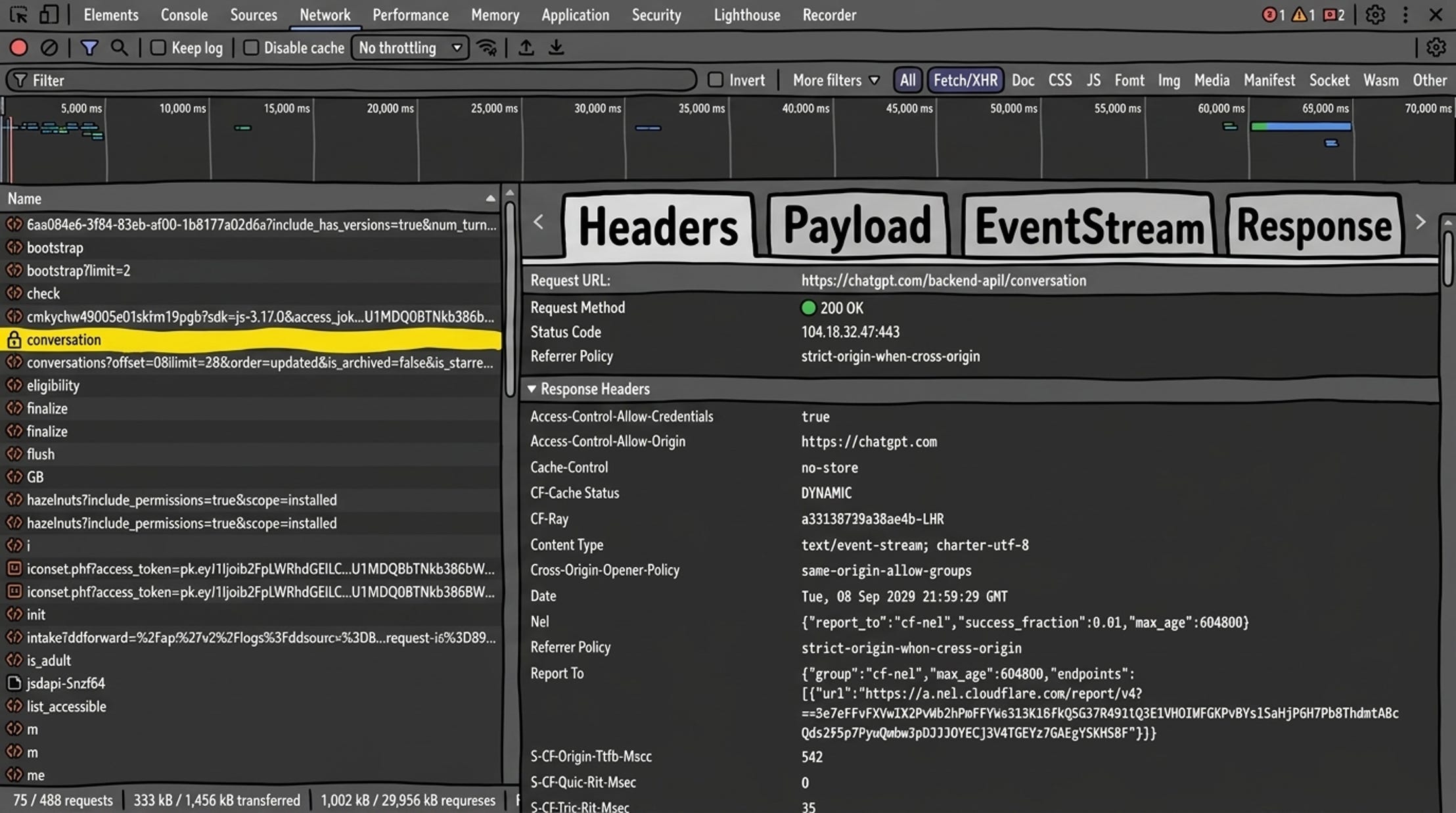
Getting at these crates is not difficult. Press F12, do a Google search or ChatGPT prompt and you are, for all practical purposes, in the Matrix. Click the Network tab, filter to Fetch/XHR, and you get a list of requests. Click on any one of them and you get a set of tabs that look intimidating and are not:
Headers: instructions and metadata about the request.
Payload: what you sent.
EventStream: what continues arriving live, as data bounces back and forth between your browser and the backend (ChatGPT uses this heavily while it is generating an answer).
Response: what you got back.
The reason this is interesting rather than merely nerdy is the way these systems are built. Mario Fischer's diagram of how Google's ranking systems fit together, assembled from the leaked Content Warehouse documentation and DOJ trial exhibits, makes the point visually: what looks from the outside like one monolithic search engine is actually a vast number of small subsystems talking to each other.
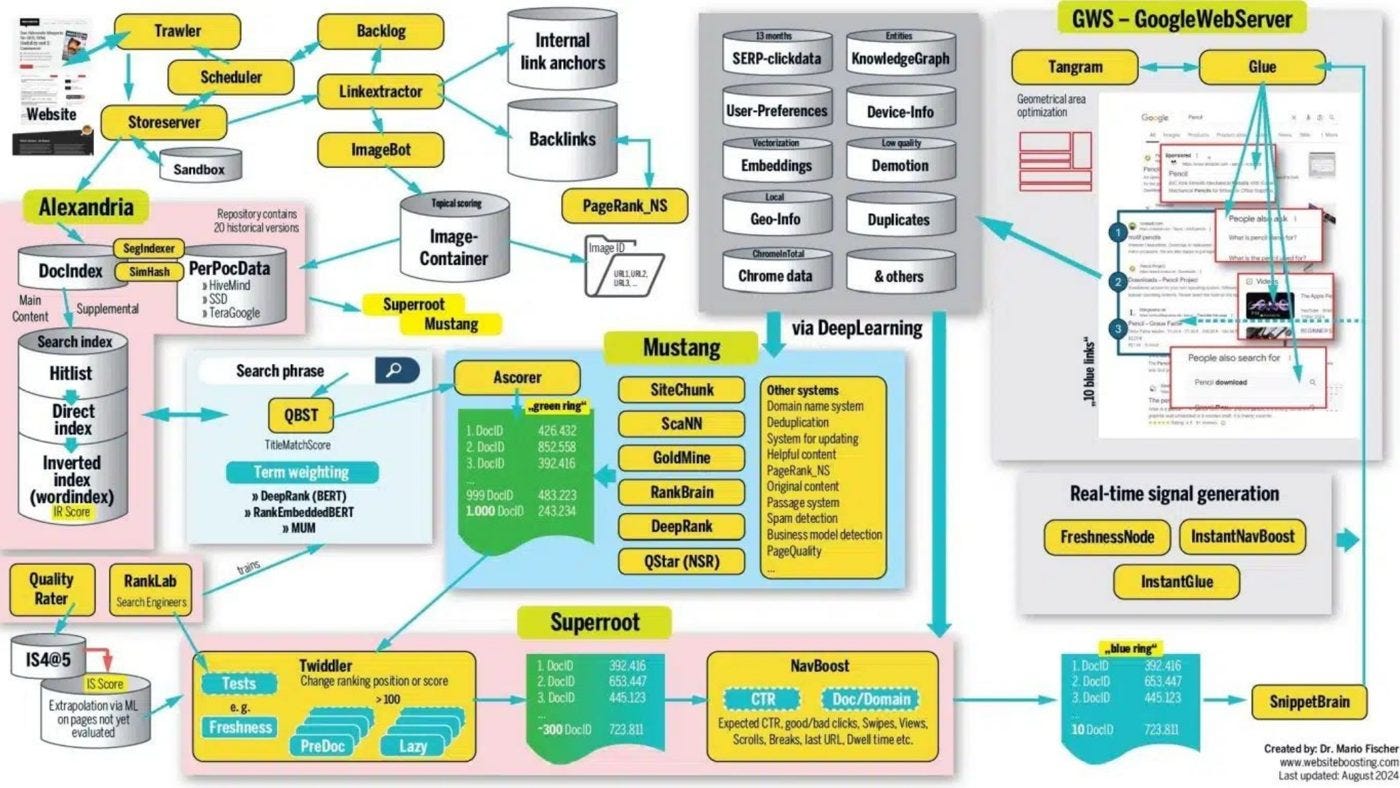
Systems at the front end, like Google’s Superroot, need to know what you searched for, and they pull in scores and signals generated elsewhere in the stack. Those scores and signals have to travel somewhere. Sometimes they travel through your browser, and sometimes nobody remembered to take the labels off.
How we found the Google exploit (a manual example)
A small confession before we begin. The reason we spend so much time doing this is that we run AlsoAsked, which involves a great deal of work with Google's People Also Ask data. I mention this so that you judge me slightly less for the amount of time I spend staring at Google's network requests. Only slightly.
While digging through request headers, we came across a callback URL with a huuugee and interesting parameter string attached to it.